Another Tack: Khartoum’s three ‘no’s’- the Ramallah version

Our media – forever plying an advocacy agenda and tendentiously promoting hyped humbug – showed no interest in focusing on Ramallah figurehead Mahmoud Abbas’s latest song and dance. Denied resonance, the story expired virtually unnoticed.

Most Israeli news-consumers were highly unlikely even to have detected any fleeting resemblance between Abbas’s three “no’s” and the three “no’s” enunciated so bombastically in Khartoum exactly 44 years and one day ago.

Representatives of all Arab League members and the PLO hobnobbed in Sudan on August 29, 1967, soon after the Six Day War. On September 1, they published their resolution, popularly dubbed “the three no’s”: “no peace, no recognition, no negotiation with Israel.”

It would serve us well to recall that this was when Israelis delusionally awaited, as Moshe Dayan phrased it, “a phone call” from Arab leaders. We sincerely convinced ourselves that given the new circumstances in the region, there’s no alternative for the Arab world but to shake off its refusal to accept Israel and to effect a lasting reconciliation. Continue reading

Another Tack: The scorpions sting – again

Left: Miri & Haim on the hood of the bus in Eilat hours before the horror. Right: Haim FurstenbergConventional wisdom contends that neither Gaza nor Cairo harbors much interest in fanning terrorist flames and disrupting the uneasy truce that has precariously prevailed since Operation Cast Lead. Egypt, an unsteady step away from uncontainable internal chaos, prodigiously presents Cairo’s caretaker military junta with other preoccupations.

Simultaneously Hamas surely doesn’t relish another punishment of the magnitude inflicted upon it in 2008.

This makes ample sense – on our wavelength. Cerebral processes in the Arab realm, however, don’t necessarily conform to our rationale. They practically never do.

Israelis shocked by last week’s roadside massacre outside Eilat and by the ensuing rocket barrages from Hamastan fall prey to excessively non-Levantine logical assumptions. They fail to understand that our concepts of levelheadedness don’t apply in neighboring latifundia. Continue reading

Another Tack: Red flags in Tel Aviv (II) –Mapai memories

So sweet is the enticement of deluxe revolution, requiring no risk or real effort, just lots of self-applied ego massages, outdoor happenings, free entertainment and nonstop media hype.

We can all feel like heroes by just coming out to hear mediocre renditions by opportunistic crooners who infuse us in high decibels with affectations of purpose and camaraderie.

Altruism isn’t part of the equation. Entitlement antics mandate no self-sacrifice. Quite the contrary.

It’s not “what I can do for my country” but “what my country can do for me.”
 While the world precariously teeters on a recessionary precipice, we indulge in anti-capitalist conniptions, incongruously powered by the profit motive.

The summer heat and humidity have finally steamed the leftovers of our collective gray matter and sent this nation into a hissy fit. Our irrationality is fueled by devil-may-care irritability. We’re seemingly ready to throw out the baby with the bathwater, to the delight of Mahmoud Ahmedinejad, Hamas, Mahmoud Abbas, et al. Boiled brains, mass neuroses, greed and trendy tantrums make us perfect patsies for political exploitation. Continue reading

Another Tack: Red flags in Tel Aviv (I) – a helpful glossary

There’s a long, dishonorable history of pro forma non-political associations that in fact were set up or propped up to serve political goals. Yet their propensities, purposes and patronage are cunningly masked in order to make their deployment more effective.

The upshot is that extremist programs are actually promoted within what are presented to public view as moderate frameworks. This wins greater support and adherence than would otherwise be the case. Even activists within these outfits are often bamboozled.

Yet no matter how clever the camouflage, there’ll invariably remain telltale clues to what really lies beneath. Intelligent citizens and news-consumers need seek out such hints and beware.

When a protest over high rents evolves into an all-encompassing clamor for “social justice,” odds are that it calculatingly conceals something so extensive, so ill-defined and hence so unattainable that non-satisfaction is a priori guaranteed. Nothing can possibly please these protest-orchestrators. All goodwill gestures will predictably fall short of their catch-all demands. Continue reading

Another Tack: Free to love Wagner

Negligible reports tucked away below the fold of forgotten inside pages oftentimes signify much more than the scant attention accorded them. So it was with news that the Israel Chamber Orchestra played Wagner in Germany at the Bayreuth Festival dedicated to his veneration. This perhaps constituted the greatest break yet of Israel’s unofficial, socially accepted taboo on public performances of Richard Wagner’s music (as distinct from listening in private).

Nonetheless, easygoing apathy greeted a story that yesteryear would have instigated riots. Classical music is anyhow the preserve of shrinking clusters of cultural aesthetes, once numerous and influential in our midst. Today, they’re judged esoteric and hardly anyone cares.

Moreover, several false premises paint Wagner-aversion as ludicrous and outdated. Wagner’s music, we’re told, shouldn’t suffer because Hitler appropriated it. The composer, after all, died half a century before the Third Reich.

Another premise is that our loathing for Wagner is insular and generation-based. Hear ICO chairwoman Erela Talmi: “The atmosphere has changed, and those people who were at the concentration camps are either weaker or no longer with us, and those who voiced their [anti-Wagner] opinions are only a few and it’s hard for them to be heard now.”

Subtext: The dead and dying survivors’ eccentricities sprang from exaggerated, no-longer-relevant emotionalism. Presumably we’re now free to love Wagner. Continue reading

Another Tack: Between Tunisia and Tel Aviv

News flash: There’s cheap rental housing in Tel Aviv. Dirt cheap. So cheap, in fact, that illegals from Ghana and Nigeria, Guatemala and Columbia, Thailand and Outer Mongolia, can afford it. But that’s not where the privileged children of the well-heeled classes wish to fulfill fantasies of FriendsSex and the City or Gossip Girl.

Indeed, the Old Central Bus Station environs, like the Shapira or Hatikva quarters, aren’t Tel Aviv’s equivalents of somewhere-fashionable-in-the-heart-of-Manhattan – where latter-day bohemians reside in style while posing as suffering artistes and empathizing with the downtrodden masses of the Earth.

The equivalents are “Heart-of-Tel-Aviv” neighborhoods (like the swanky Sheinkin drag), even select elitist edges of Jaffa and that glorified-gentrified Florentin niche. But topping it all for prestige and desirability is Tel Aviv’s “Old North,” radiating from the upmarket Habimah Theater-Mann Auditorium hub.

At that posh pivot, trendsetters and groupies pitched their tent city to campaign for lower/subsidized rents. We, wage-earners in the rest of the country, are presumably required to foot their extravagant bills and make Israel’s Manhattan ambiance more affordable. Since Manhattan is so overpriced, the affectation becomes more attainable in the homeland, in conditions of comparable comfort and proximity to social focal points – where it’s all happening.

That, however, as elsewhere in the world, is where it’s most expensive to rent the proper setting for the pretentious pipe dream. It’s location, location, location – the greater the demand, the higher the price-tag. Continue reading

Another Tack: Boycott is beautiful

Only Sigmund Freud could probably account for why strains of “Suicide is Painless” (the M*A*S*H theme song – in both the 1970 movie and subsequent TV series) pulsated inside my cranium each time the anti-boycott bill was being rehashed on our airwaves.

Whatever the subconscious trigger, the lyrics (written by director Robert Altman’s 14-year-old son) evolved as they reverberated in my mind’s ear. The refrain “suicide is painless” soon morphed into “boycott is beautiful.”

Resorting to amateur psychoanalysis, I could vaguely work out what led me to regard boycotts as beautiful. I must have subliminally succumbed to all that high-minded leftist palaver about boycotts constituting a legitimate form of free speech. As such, boycotts become a positive expression of human rights.

My own appreciation was thoroughly grounded in historic precedent. The benefits of boycotts are undeniable.

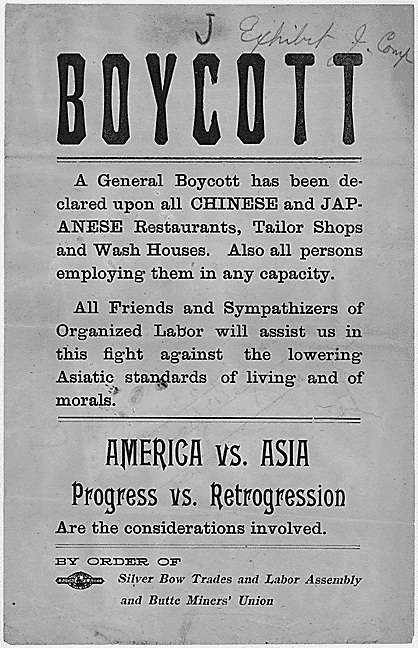
For example, in the 1870s, the Anti-Coolies Association and the Supreme Order of the Caucasians initiated boycotts of Chinese businesses and laborers across America’s West. Continue reading

Another Tack: Double standards to uphold

We call them men of letters, peace activists, democracy’s champions and human rights campaigners.

We never, ever call them extremists. The word “fanatic” couldn’t be remotely considered in reference to the sensitive, caring and agonized denizens of Israel’s political Left.

Only reputed right-wingers are maligned as extremists, fanatics, fascists, rabble-rousing inciters, enemies of democracy, lawbreakers, wreckers of peace prospects, and/or demolishers of our way of life. In fact, Israel’s Left-dominated media even decides for us which baddies to brand right-wingers. Continue reading

Another Tack: Memo to kibitzers and kvetchers

Israel’s ambassador to Washington is the guest at a prestigious nationally televised interview series, but is soon set upon by his particularly pugnacious host. The strikingly prosecutorial interviewer homes in on “the charge that Israel threatens world peace with a policy of territorial expansion.”

He quotes “a major Arab spokesman” who asserts that “the area of the territories held by Israel today exceeds by about 40 percent the area of the territories given Israel by the United Nations. Most of this added area… was taken by force, and should therefore be relinquished by Israel.”

Ho hum. So what’s the big deal? Aren’t we habitually painted as insatiable gobblers of Arab land, and aren’t we just as routinely required to cede our “ill-gotten” gains?

True, this could all have been a colossal bore, were it not for the date of the above face-off. It took place on April 12, 1958, shortly before Israel’s 10th birthday. And that makes Abba Eban’s appearance on The Mike Wallace Interview program supremely important. Continue reading

Another Tack: Schlemiel, schlimazel …

There’s a well-defined distinction between a schlimazel and a schlemiel. The former is the one on whom soup is spilled, while the latter is the one who spills it. In the rare instance that both categories of klutziness coalesce in one persona, it’s an out-and-out disaster. Such an embarrassing, uncommon confluence of bad luck and clumsiness may go a long way toward accounting for Amir Peretz’s incredible recurrent gaffes.

The one in which he sat alongside then-chief of staff Gabi Ashkenazi in February 2007 and inspected paratroop maneuvers on the Golan through capped binoculars far exceeded the merely preposterous. It was more like a symbolic embodiment and accentuation of how Peretz and the lame Olmert government in which he served as defense minister looked out for Israel’s most critical security interests.

There Peretz was, peering intently into opaque black plastic lens-covers, yet nodding – apparently knowingly – to explanations by the IDF’s top commander. Peretz focused attentively, as if he actually saw something and even made professional sense of what he so keenly observed. This farce, seemingly straight out of a Marx Brothers madcap spoof, was repeated no fewer than three times on that one occasion.

In truth, though, it doesn’t much matter what Peretz did or didn’t see that morning. His peerless brand of piercing perception and knack for disregarding empirical evidence was recurrently demonstrated throughout the Second Lebanon War (to resort to extreme understatement). All these years later, and his ignominious resignation from the defense helm notwithstanding, Peretz is still avidly at it, still superciliously confident of his uncanny insight, still seeking to convince us that no one gets things as right as he does. Continue reading