Another Tack: Saccharine for the masses

On the first anniversary of the October 26, 2005, suicide-bombing in Hadera’s open-air marketplace, the city organized a memorial for the six victims (the seventh lingered and died of her injuries four years after the blast). The families expected a solemn, respectful occasion. It was anything but.

Michal Machlouf, who lost her mother Pirhiya in that atrocity, came away feeling alienated: “Municipal politicians heartily slapped each other on the back for having successfully reconstructed the market. Our tragedy became their vehicle for unabashed campaigning and expedient self-congratulation. Mom’s name was misspelled on the commemorative monument, and we felt surplus to requirements. It was obvious that the organizers couldn’t wait for the bereaved relatives to go away, because we were killjoys. We focused on the blood, while they had very nimbly moved on.”

The same sense of alienation resurfaced during the exhilaration sparked by Gilad Schalit’s release: “I’m pleased he’s back, but this outburst of euphoric festivity is so out of place, so unseemly and so unfeeling. Again we, families of terror victims, were made to feel like killjoys, like burdens who remind the celebrants of horrors-that-were and of horrors-to-come. Despite obligatory lip service, nobody wanted to remember the past or think about the future.” Continue reading

Another Tack: A sacrifice in vain?

The electoral race I covered in 1981 was the most contentious I remember. It followed the 1977 upheaval in which a non-Labor government for the first time became a plausible option. Behaving as if it were robbed of its rightful legacy, Labor aimed to correct the voters’ “error.” The end justified any and all means.

And so one evening, Yossi Sarid, who was Labor’s campaign spokesman, charged that the Likud had planted a suitcase packed with explosives outside Labor’s campaign headquarters at Tel Aviv’s Deborah Hotel. Automatically I phoned the police to inquire and was informed in no uncertain terms that an innocent tourist had inadvertently forgotten his bag at the entrance to a travel agency next door to the Deborah.

What did this have to do with a bomb? Nothing. What did this have to do with Labor? Nothing. What did this have to do with the Likud? Nothing.

Nevertheless, instead of praise for journalistic due diligence, I was subjected to the most vituperative chewing-out of my career. My bosses severely rebuked me for not trusting Sarid, for checking up and, most of all, for including the police version in my story. I was accused of no less than deliberate sabotage and asked in exasperation why I just won’t write what I’m told. In other words, I was taken to task for not toeing the party line.

This 30-year-old reminiscence remains pertinent. Continue reading

Another Tack: Yesteryear’s peculiar predictions

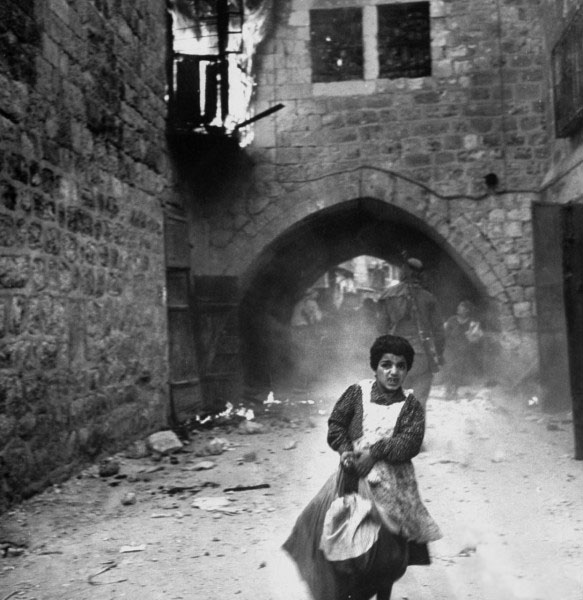
Seven-year-old Rachel Levy flees Arab occupiers in the old city of Jerusalem as her home goes up in flames.

Back in 2003 I warned in several columns and editorials that by acquiescing (for seemingly pragmatic reasons) to the delegitimization of settlements we also delegitimize our standing in Jerusalem.

“For much of the world,” I noted in an editorial for Jerusalem Day 2003, “many sections of Jerusalem are settlements – no less than Ariel or Ofra. The neighborhood of Gilo, home to more than 45,000 Jerusalemites, is routinely described abroad as ‘the Gilo settlement.’ This can impact on the continued development of many city quarters. It’s not inconceivable that the Arabs will decry any development as an infringement of strictures set in the ‘Roadmap to Peace’ while the International Quartet, slated to oversee the process, may well agree.”

At the time, I recall, the reaction was that I had “exaggerated wildly” and “stretched things out of all proportion” to make a point that was in itself quite outlandish, if not outright scaremongering. No way would our claim to Gilo ever be compromised and no way would any friendly force ever dare insist we curtail construction in so quintessentially an Israeli neighborhood. Continue reading

Editorial: Shechtman’s kudos

Israel merits a pat on the back following the announcement that this year’s Nobel Prize for chemistry was awarded to Tel Aviv-born Technion professor Dan Shechtman, father of the new field of quasiperiodic crystals. As a nation we’ve earned a respite from our daily litany of grumbles and gripes.

We’re a small country with almost everything possible going against it. We inhabit a minuscule strip of harsh topography, with no natural resources to speak of and an arid climate to boot. Moreover, we aren’t allowed to inhabit this inhospitable sliver of land – in which we literally built everything from scratch – in peace. We’re repeatedly besieged, boycotted, attacked, threatened with outright genocide, delegitimized and demonized. This would constitute a cumbersome load for any undersized nation, though none has been subjected to anything approaching our still-ongoing travails and dangers.

Yet despite it all, we are a tiny set-upon nation with no fewer than 10 Nobel prize-winners. Continue reading

Another Tack: The nudnik’s oft-kibitzed refrain

Indubitably the worst kind of nudnik is a kibitzer and the worst kibitzer is the incorrigible chronic sort who just won’t let go, who is so full of himself that he utterly fails to realize what a tiresome, preposterous broken record he has become.

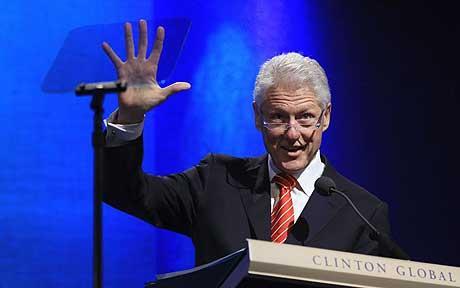
Bill Clinton, US ex-president and darling of all too many of his country’s inveterate Jewish liberals, doubtlessly knows that the Yiddish- derived “nudnik” denotes a nag, a pest and an all-around nuisance. At about the same time as “nudnik” became entrenched in American colloquialism, the Yiddish verb “kibitz” likewise entered the lexicon and its current dictionary definition is “to intrusively offer unwanted, meddlesome advice to others.”

Nudnik Clinton kibitzes with habitual relish, as if his assertions are valid and as if his judgmental pronouncements still count.

No matter how hard we try to consign him to the hindmost recesses of our memory, he keeps popping up with another exasperating rerun of the irksome old routine. Continue reading

Another Tack: Optimism was compulsory

Israeli babies born this month 18 years ago are now old enough for the draft. Some are already in uniform while others soon will be. They were born under the Oslo sign. It seemed a great time to come into the world.

They took their first breaths as the Oslo accords were inaugurated with whoops of rapture. Niggling doubt was politically incorrect and accordingly drowned out with heaps of scorn and wrath in the name of goodwill and broad-minded tolerance. Optimism was compulsory.

But, looking back, was optimism vindicated? Had the Oslo dreams panned out and even partially justified the hype, there would be no more need to train any more 18-year-olds in the arts of war – especially this very symbolic batch of 1993-vintage recruits. Continue reading

Another Tack: From bakshish to Khaybar

In many ways Egypt-present isn’t like Egypt-past. In many ways nothing in Egypt has changed at all.
Herein prevails the paradox. Egypt is a bedeviling composite of the mutating and the immutable.

I described its immutability years ago, when recalling my first work assignment to Egypt. In those days peace with Israel hadn’t yet been thoroughly delegitimized among the broad lower strata of Egyptian society (as distinct from the razor-thin so-called intelligentsia).

Yet it was a frustrating (pre-Internet) time. The Jerusalem Post’s then-editors wouldn’t hear of footing the bill for long-distance telephone communications. Reporters from other Israeli papers weren’t likewise impeded. I had to travel by cab alone each night – over an hour each way – from our well-secured hotel to Cairo’s Reuters headquarters to file my copy by telex. Continue reading

Another Tack: That Beilinesque mind-set

Our homegrown self-appointed guardians of collective conscience also inevitably – by their own testimony – corner the market on all available good sense. They persistently analyze our assorted predicaments and without fail arrive at the same judgment – Israel is to blame.

Specific circumstances and incidental details notwithstanding, it’s always our moral lapse and/or misguided conceptions that make us mess up massively. We need only be more virtuous or more sagacious (obviously as per their flawless recommendations).

The other day Yossi Beilin – ex-minister, pivotal Oslo protagonist, Labor Party headliner and later Meretz hotshot – published an op-ed in Yisrael Hayom omnisciently instructing us all on where we erred vis-à-vis Turkey. And thus he sermonized: “There comes a moment when a state must weigh what’s dearer to its heart – diplomatic, military and economic ties with a very large Muslim country whose influence in the region grows, or insistence on the truth, as it perceives it, and on what it interprets as national honor.”

Beilin’s preferences are unequivocal – we should have opted for the bounty clearly accruing from chumminess with Turkey and apologized abjectly for our legitimate self-defense in the Mavi Marmara incident. Considerations of national honor, he more than implies, are irrational, if not outrightly insane. Continue reading

Another Tack: The real danger

It’s a decade since 9/11, an anniversary that must provoke uneasy thoughts everywhere – including, for instance, on US President Barack Obama’s perspectives.

But does it? Kadima headliner Tzipi Livni recently granted an interview to The Atlantic magazine in which she waxed ecstatic about Obama’s pressure on Prime Minister Binyamin Netanyahu and zealously recommended more.

It’s as if a cynical, self-willed disconnect from our realities caused Livni to forget her own tenure as foreign minister and rendered her bizarrely oblivious to Obama’s worldview.

Otherwise she’d have recalled that two years ago, when addressing Turkey’s parliament, Obama expressed profuse appreciation “for the Islamic faith, which has done so much over so many centuries to shape the world for the better, including in my own country.”

This is Obama’s recurrent and persistent theme. “We are not at war with Islam,” he has declaimed repetitively on numerous occasions. By inference, neither is Islam at war with America, or, for that matter with Israel – to say nothing of any other democracy where Muslim terrorists have set off an explosive device or two. Continue reading