Another Tack: Judenfrei is fine and dandy

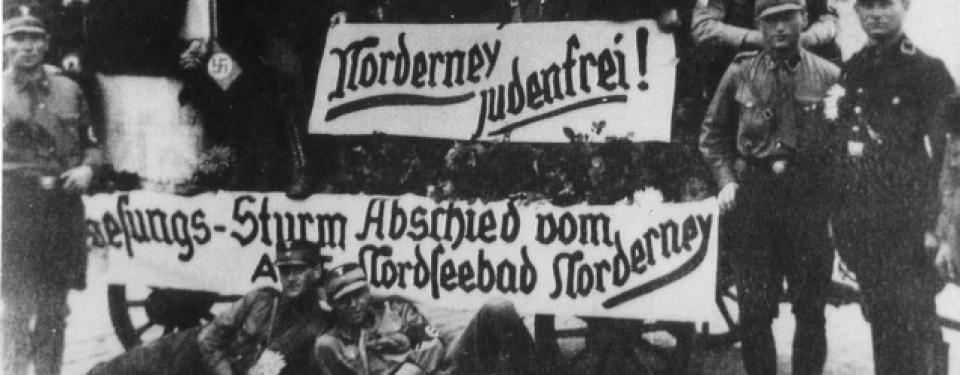
SS men celebrating Judenfrei statusIn practically two post-Oslo decades, Ramallah’s negotiators haven’t budged a fraction of a millimeter from their initial positions. In that span of unfortunate time, Israel had continually slipped back and now accedes to what would have been unthinkable for our mainstream in 1993.

The current two-state sine qua non – an ostensibly indispensable and unquestionable ingredient of any just Mideast deal – would have been a clear non-starter in Israeli public discourse pre-Oslo. But recurrent concerted assaults – both from overseas and from our domestic left-wing – on the very cornerstones of what were Israel’s self-evident truths, left us shaken and demoralized.

As a result, the traumatized citizenry began rationalizing the deviations from our fundamental postulates as feasible moves towards a doable peace. Israel’s Left pulled our entire political arena fitfully ever farther leftward. The more its predictions crashed against the hard wall of reality, the more the fantasy-merchants insisted that their premise wasn’t wrong but that we just didn’t give in enough. Continue reading

Another Tack: Who’s the sucker?

If you’re playing poker and look around the table to see who the sucker is, it¹s doubtless you (by Spanish artist Ulpiano Checa y Sanz, 1891)Almost five years ago the foreign ministry, then under the aegis of Tzipi Livni, published the following official press release:

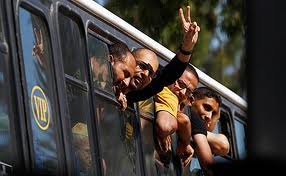
On 25 August 2008, Israel released 198 convicted Palestinian terrorists. Israel undertook this risky measure in the hope of promoting dialogue with the pragmatic Palestinians who reject terrorism and are engaged in diplomacy with Israel.

It is never easy for Israel to decide on the early release of convicted Palestinian terrorists. The issue is one fraught with emotional overtones, for Israelis in general and the families of terrorism victims in particular.

In these instances, Israel’s decision-makers have been faced with both political and moral dilemmas. All the while, they remain fully cognizant of the security risks posed to the Israeli public by such measures. Continue reading

Another Tack: It’s all connected

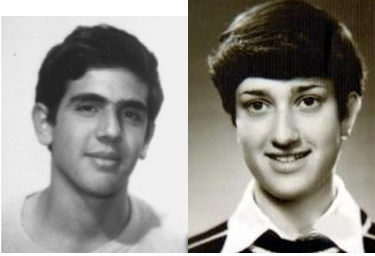
David Delarosa and Rachel WeissAll the seemingly disjointed fragments of news that maddeningly disrupt the steamy summertime tediousness are in fact interrelated – disturbingly so.

The purportedly enlightened campaign against Jewish circumcision and the equally sanctimonious outcry against kosher slaughter (most gallingly and recently in the very same Poland whose soil is soaked with Jewish blood like no other spot on this planet) are links in the same chain that led to the European Union’s burgeoning anti-Israeli boycott (disingenuously hinged on the settlements pretext) and to US Secretary of State John Kerry’s artificial resuscitation of the moribund and grossly misnamed peace process (that hinges on the release of convicted murderers whose hands drip with Jewish blood).

The fact is that those who cannot abide ancient Jewish rituals for a variety of insincere excuses and who seek excuses to justify double standards against the Jewish state, stayed eerily silent when the Palestinian Authority demanded liberation for some of the most heinous perpetrators of hate crimes since the Holocaust (which Europe assiduously attempts to banalize/belittle). Continue reading

Déjà vu – again

image001Our memories tend to be so short that all too often déjà vu looks brand new. This is the case with the looming release of 82 convicted terrorists to facilitate the opening of yet another round of negotiations with the Palestinian Authority. But we’ve been there and seen that.

Demanding “gestures of goodwill” and “confidence building measures” from Israel as a price for showing up for talks is a routine Palestinian tactic. It crops up with each attempt to resuscitate contacts and always takes the same shape. Continue reading

Another Tack: Where crazies thrive

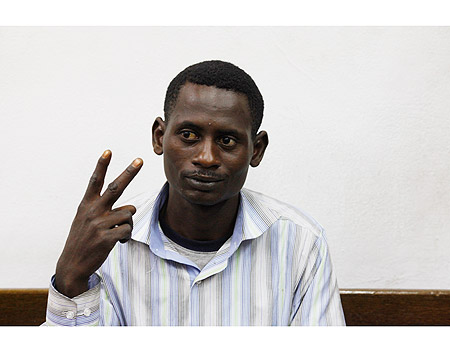
Suleiman Abdul-Adham insolently gestures the V-sign during his arraignment in courtTo contextualize the provocations of the so-called hilltop youth, and the possibly linked price-tag inanities, we need to visit unloved and forsaken southern Tel Aviv – From Neveh Sha’anan all the way to the Hatikva and Shapira Quarters. Their sordid streets offer an improbable but pertinent perspective for the barren rocky landscapes of Judea and Samaria.

It’s not instantly obvious but there’s much that ties the denizens of these seemingly disparate settings. In a word it’s disaffection.

Our mainstream doesn’t care about the Israeli remainder in areas of Tel Aviv that had ceased to matter to trendsetters. The same goes for those broadly denigrated as “settlers.” Tenaciously clinging to values long ago discounted by conceited talking heads, they’re physically and psychologically removed from Tel Aviv’s clubs and cafes, besides being anathema to the in-crowd’s fashion police.

The stories of those whom stuck-up snobs disown – whether they live only several run-down blocks away or beyond the sacrosanct Green Line – get no hearing, to say nothing of sympathy. Continue reading

Another Tack: Iran’s Latterday Goering

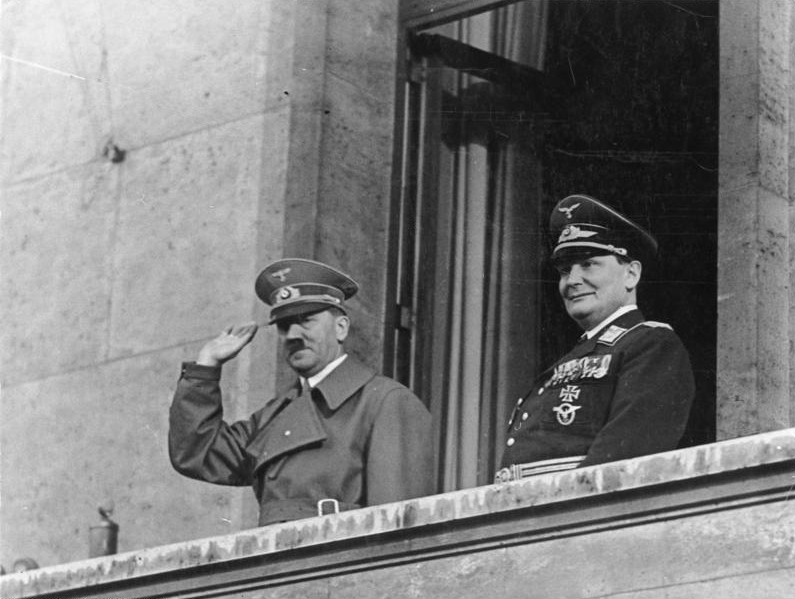
The Fuehrer and his front-man- Hitler and Goering on March 16, 1938.It was gut-wrenching to watch the world fawn over Iran’s new president. It was even more sickening to see ignorance parading as astuteness and profound insight.

We can only be mystified by how all those who never previously heard of Hassan Rohani instantly knew he was a famous moderate, that his election was a blow to Iran’s Supreme Leader Ayatollah Ali Khamenei, that Khamenei was exceedingly upset by the people’s choice, even that he greeted it with a sour expression.

The consensus among the overnight experts on an esoteric arena was that the vote was a runaway surprise, where the forces of good walloped the forces of evil.

Non-too-amazingly, the White House orchestrated the optimism. US President Barack Obama’s chief of staff informed us that Rohani’s victory was a “potentially hopeful sign” and that if Mahmoud Ahmedinejad’s successor behaved well, “he will find a partner in us.” Spinning the spin on CBS’s Face the Nation, Denis McDonough exuded hope: “If he [Rohani] is interested in, as he has said in his campaign, mending Iran’s relations with the rest of the world, there is an opportunity to do that.” Continue reading

Another Tack: Love at a Price

.There’s something unsavory in taking on very elder statesmen, especially nonagenarians or near-nonagenarians. It seems so uncouth, so unkind, so unfair – just as it would be to slap around helpless little tots or kick cute big-eyed puppies.

Therefore, for many months I struggled hard to suppress my inclination to carp – while preparations for yet another sumptuous birthday bash for our phenomenally spry president, Shimon Peres, got underway with fitting fanfare. But even the most stringent self-control has its limits. In the end, I am succumbing to temptation.

Why? Maybe because too much sometimes really is too much. Continue reading

Another Tack: Plucky in pajamas

Unlikely hero Levi Eshkol at his deskIn our collective memory Levi Eshkol is perceived as a weak, even a vacillating prime minister. Perhaps this was unjust already back on the eve of the Six Day War, when his image became thus ingrained in our popular lore. Certainly, compared to many of his successors in ensuing decades, Eshkol can be portrayed as a resolute upholder of Israeli national pride – especially when clad in pajamas.

Merely by refusing to change into proper daytime attire, Eshkol struck a plucky patriotic pose. In his humble night clothes he evinced more audacity than most of the wishy-washy variety that followed him in office.

Eshkol took his steadfast stand in the ungodly hours of May 27, 1967, when Soviet Ambassador Dmitri Chuvakhin arrived on the PM’s doorstep and demanded to wake him up to deliver an urgent message from Moscow. The envoy insisted he couldn’t wait till dawn. Continue reading

Another Tack: A very Israeli story

Gershon Israeli (left) at age-11 and his cousin Ya'acov in Kibbutz GvatOver the years I have translated to English some of the Hebrew poems I found most evocative and/or meaningful to me personally. Among them are quite a number by Fania Bergstein. Her name most likely means nothing to most Israelis, although so many know her rhymes by heart. They just aren’t aware of who wrote them, who enriched our childhood, whose lines became cherished household staples.

Amazingly, Fania Bergstein faded into undeserved anonymity. But she’s important to understanding our Israeli identity, why we are here, what moves and motivates us.

She died young, at age 42, some 17 years before the Six Day War to which she is tragically connected. There is relevance to remembering her these days when we mark another anniversary of that 1967 showdown, which has increasingly become yet another occasion to besmirch our self-defense, demonize us as land-grabbing imperialist ogres and castigate us for having inconsiderately emerged victorious.

Fania provides context and connections to who we really are. Hers is a quintessentially Israeli story – not only figuratively so. Israeli was her married surname. Continue reading

Turkish Tumult

image001 (2)Much as the zeal to compare entices, it would be wrong to liken the disturbances in Turkey to those of the misnamed Arab Spring.

Foremost, they don’t spring from the same source. Although the Islamist government headed by Recep Tayyip Erdogan is nowhere near as tyrannical as Iran’s ayatollahs, the protesters in Istanbul have more in common with those who took to the streets of  Tehran in 2009, than they do with the masses who toppled Arab despots in recent years.

The latter instigated mayhem for a variety of reasons which were nothing like the yearnings for civil liberties that the West wrong-headedly ascribed to them. Arab insurgencies were fuelled both by Islamic reactionary fervor as well as by ethnic/tribal divisions. Arab civil-libertarians were scant and soon drowned out in the turmoil.  Continue reading